
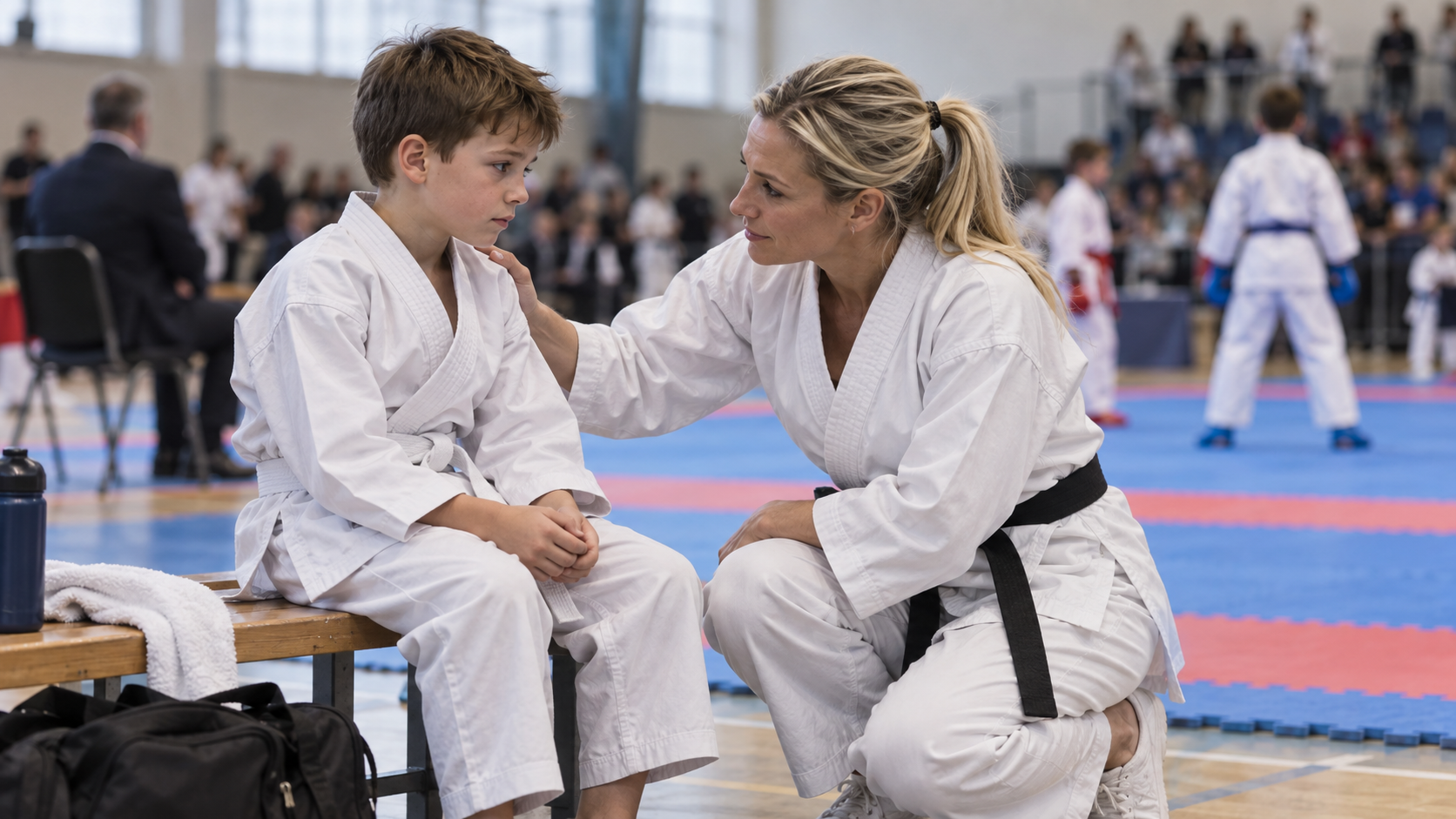
A child’s first karate tournament brings a mixture of excitement and nerves for the parents as much as the student. After months of training, trips to the dojo and all the effort they have put in, it is natural to hope they will come home with a medal.
There is nothing wrong with wanting your child to win. We celebrate their achievements because we know how much work goes into them. But from a Kyokushin perspective, I believe a first tournament can offer something valuable even when the result is disappointing.
Sometimes, losing that first competition teaches a young karateka lessons that a gold medal might not.
What a First Karate Tournament Teaches Children
Training in the dojo and stepping onto a tournament mat are very different experiences. In the dojo, students know their instructor, their training partners and the familiar rhythm of a session. They can practise, make mistakes, receive guidance and try again.
At a tournament, that familiarity disappears. There are unfamiliar opponents, referees, spectators and noise. Waiting for their name to be called can feel like a challenge in itself. Then they step onto the mat and discover what it feels like to perform under pressure.
A child who looks confident during training might suddenly hesitate. Techniques they have practised for months may be difficult to remember or apply. They might tire sooner than expected or struggle to respond when their opponent keeps moving forward.
None of this means their training has failed. It means they have encountered a new experience and their instructor now has something concrete to help them work through.
How Losing Can Give Training a Clearer Purpose
“Keep your guard up” feels different after a fight in which a student struggled to defend themselves. Fitness work has a clearer purpose when they remember how tired they felt in the final moments. Practising their footwork becomes more meaningful when they understand how difficult it was to move away from pressure.
After a loss, a student and their instructor can identify specific things to work on. Perhaps they need to improve their stamina, become more confident moving forward or practise staying calm when an opponent puts them under pressure.
The lesson has become personal. With encouragement and the right guidance, that experience can give their next training session a new sense of purpose.
They begin to understand why we ask them to repeat techniques, work on their conditioning and keep going when training becomes challenging.
Supporting Your Child After a Tournament Loss
A child may leave the mat upset, frustrated or in tears. That does not mean they lack strength or the right attitude for karate. They cared about the result. They wanted to do well, and things did not go as they hoped.
In that moment, “It doesn’t matter” may not be what they need to hear. To them, it matters very much.
Sometimes the most helpful response is simple:
“I know you wanted to win. It’s okay to feel disappointed. I’m proud of you for getting out there.”
There will be time to reflect later, once they have had a chance to settle. We do not need to turn the journey home into a detailed review of every mistake. Their instructor can help them understand their performance and choose a few manageable things to improve.
As parents, we can listen, reassure them and remind them that one result does not change how we see them.
Helping Children Learn Without Making Excuses
It can be tempting to blame the referee, dismiss the opponent as lucky or insist that our child was the better fighter. We want to protect their confidence, but automatic excuses can make it harder for them to learn honestly from the experience.
Genuine concerns should be raised appropriately with the instructor. Alongside that, we can help children recognise what remains within their control: their preparation, effort, attitude and willingness to improve.
Once they are ready to talk, gentle questions can help: “What felt difficult?” or “Is there anything you would like to practise before next time?”
The aim is to help them recognise that improvement is possible, without making them feel that they have let anyone down.
Learning Perseverance Through Kyokushin Karate
For me, this is where the Kyokushin spirit expressed through Osu becomes meaningful.
Perseverance takes practice. Returning to the dojo after a disappointing result, listening to feedback and working on something difficult are all part of developing it. So is finding the courage to compete again when they feel ready.
That progress may be easy to miss if we focus only on medals. A student who returns to training with determination has taken an important step. So has the child who learns to manage their nerves or finishes their next fight feeling more confident.
Losing alone does not build confidence or resilience. What matters is how we support a child afterwards and help them take the next step.
A First Tournament Is Just the Beginning
Winning a first tournament is worth celebrating too. A young winner still has plenty to learn, just as a young competitor who loses has plenty to be proud of. Neither result tells the whole story of their ability or their future.
At HAITO KARATE in Peterborough, we want our students to feel proud of their progress, respect their opponents and keep learning through both success and disappointment.
Their first tournament is one experience in a much longer karate journey. A medal would be a wonderful memory, but discovering that they can face disappointment, return to training and try again may stay with them for far longer.
Osu! 🥋