
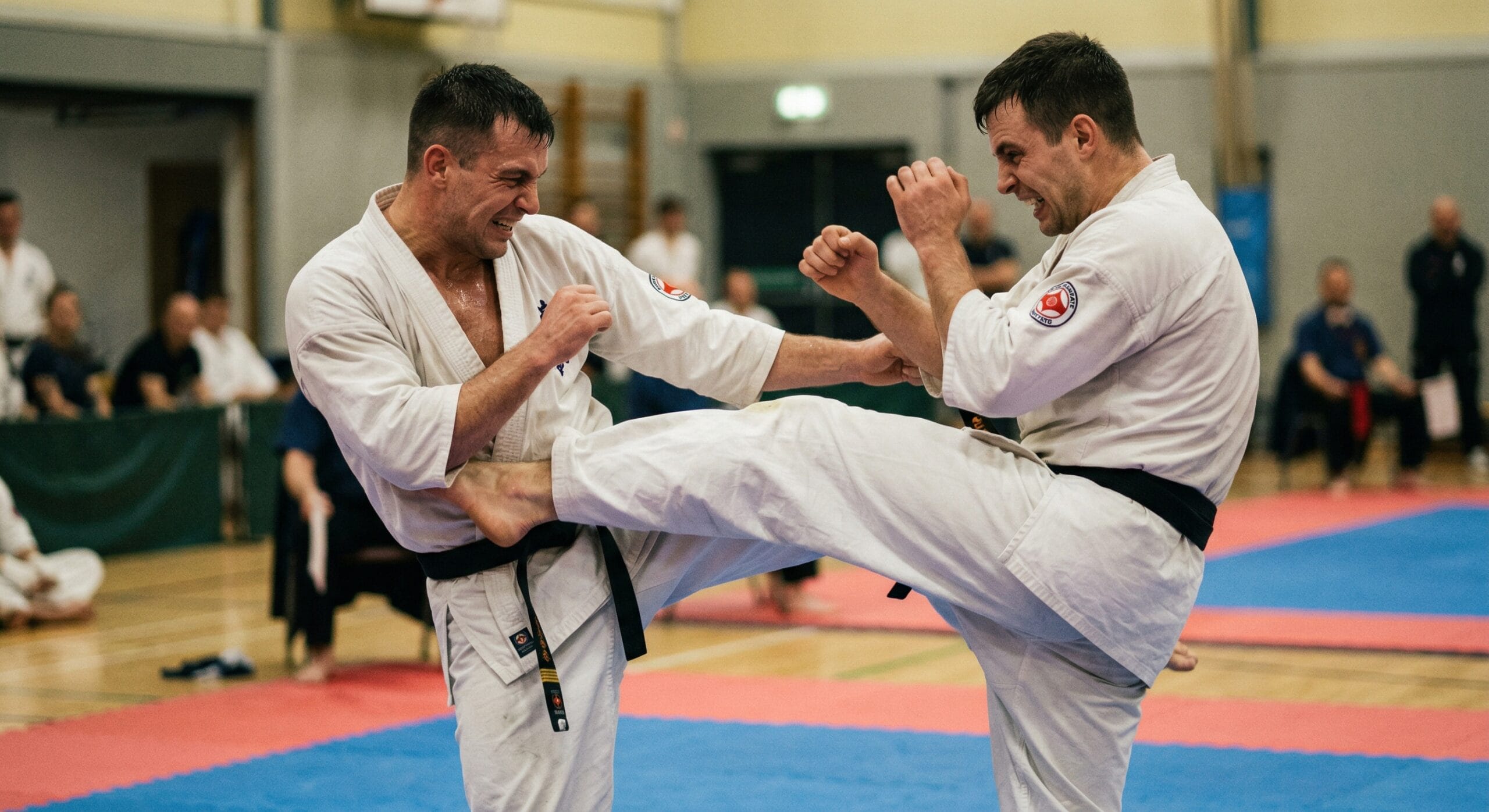
If you’ve ever watched a Kyokushin karate tournament—or waited nervously on the sidelines while someone you know competed—you might have noticed something unusual. Even the most elite fighters usually go home with just a single medal or trophy.
One. Not three. Not five. No one is entering every category “just for fun”.
It isn’t because they lack ambition. It’s because Kyokushin tournament rules aren’t built that way—and honestly, your ribcage will thank you for it. Here is why you won’t see Kyokushin practitioners “medal-chasing” across multiple divisions.
Full-Contact Means… Well, Full Contact
Let’s be clear: Kyokushin is not a “tap and point” sport. There’s no gentle “boop” to score and reset, and you aren’t collecting points like a supermarket loyalty card. This is full-contact karate.
In Kyokushin Kumite (fighting), people hit, and people get hit. Repeatedly. By the end of a single three-minute match, you’re already questioning your life choices. By the time you’ve progressed through multiple rounds in a single division, you’ve earned that trophy the hard way.
The physical toll of full-contact fighting makes entering multiple categories not just difficult, but medically ill-advised.
Strict Categorisation (For Your Own Safety)
Kyokushin tournaments are strictly organised by:
- Age
- Weight
- Grade (Kyu/Dan level)
- Gender
You don’t get to mix and match like you’re ordering a meal deal. You can’t decide to “try” the lightweight division and then jump into the heavyweights for a challenge.
These divisions exist for safety and fairness. In a full-contact environment, size, strength, and physical development matter immensely. A mismatch isn’t just a “learning experience”; it’s potentially dangerous. The rules are strict, non-negotiable, and designed to ensure that when you step onto the mat, you are facing a peer, not a physical impossibility.
One Division is a Marathon, Not a Sprint
In Kyokushin, your division is your only battlefield for the day. Within that single category, you may have to fight four, five, or six times to reach the podium.
The format typically follows:
- Elimination Rounds
- Quarter-finals
- Semi-finals
- Finals
Each fight takes a chunk out of your energy, your breath, and occasionally your ability to walk normally. By the time you reach a final, you aren’t thinking, “I’d love to do this all over again in the Open Weight category!” You’re thinking about ice packs, water, and perhaps a new set of legs.
Kyokushin vs. Point-Based Karate
You might see athletes in other martial arts (like WKF/Point Karate or Taekwondo) draped in five different medals. In lighter-contact or point-based competitions, entering multiple divisions is common. Because the physical impact is lower and the “reset” happens after every point, the recovery time is faster.
Kyokushin is a different universe. Here, the emphasis is on Osu—perseverance, power, and spirit. You aren’t just scoring; you are surviving, adapting, and pushing through genuine physical resistance. Letting fighters jump between divisions would go against the spirit of the sport and would likely require a permanent medical team on standby.
One Medal, Maximum Meaning
So, while a Kyokushin competitor might only bring home one trophy, that piece of silverware represents:
- Success across multiple full-contact bouts.
- Strict adherence to safe, fair competition.
- Extreme physical and mental endurance.
- The “Spirit of Osu”—the will to keep going when your body is begging you to stop.
It’s never “just one medal.” It’s the only medal that matters.
Final Thoughts
In Kyokushin, you don’t collect medals—you earn them, one brutal round at a time. The next time you see a fighter holding a single trophy, don’t ask, “Only one?” Instead, understand that for a Kyokushin fighter, one is definitely enough.